
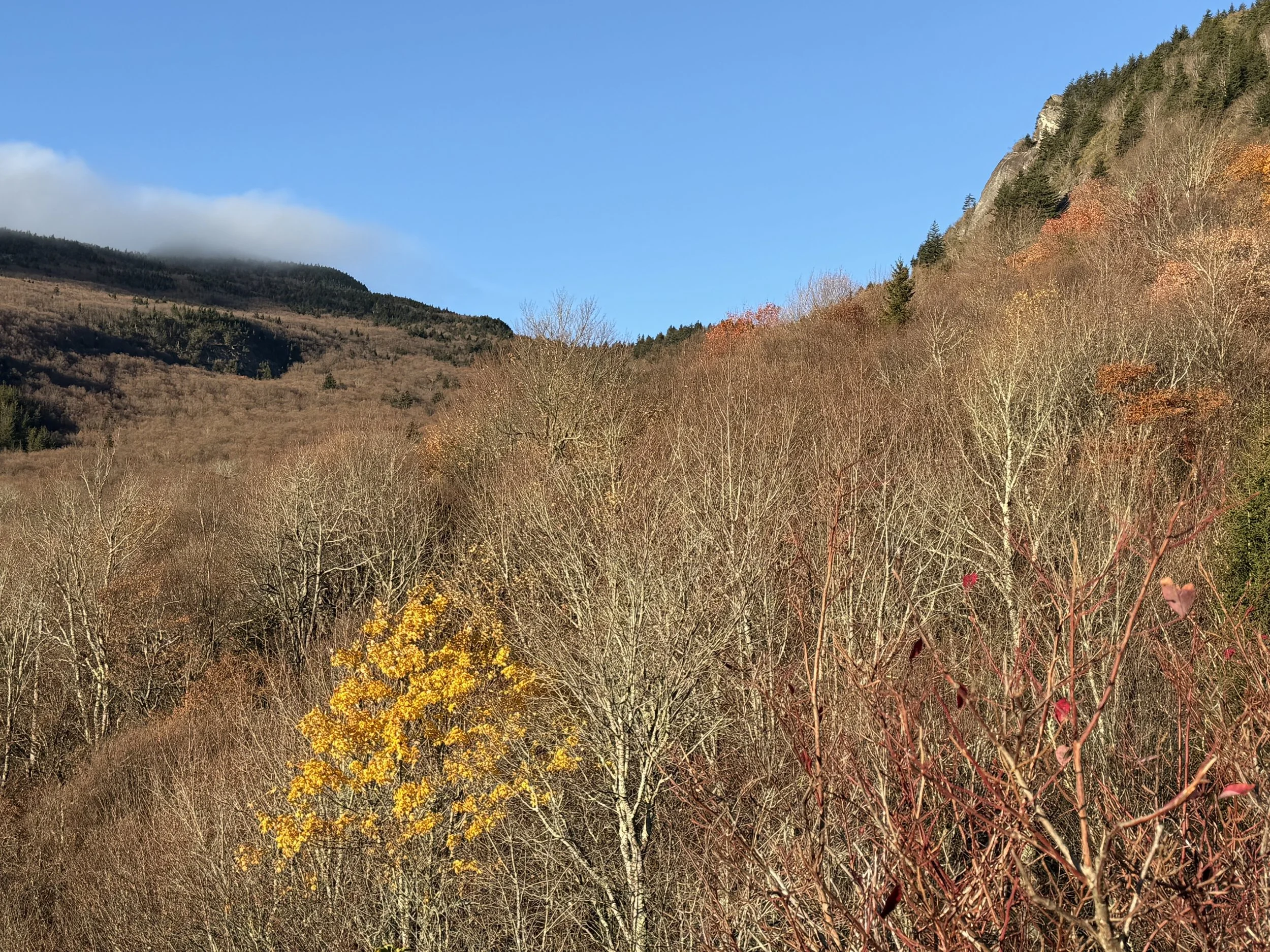
I took this photo at Storyteller’s Rock - Boone Bowl area last week during a backpacking trip with my son at Grandfather Mountain State Park. We parked along the Blue Ridge Parkway, milepost 299.9 at the Boone Fork Parking Area. Grandfather Mountain has the Cherokee name Tanawha that translates to “a fabulous hawk or eagle” while European pioneers renamed the area seeing cliffs looking like an old man. We hiked along the Nuwati Trail derived from the Cherokee name meaning “medicine or life force energy.” We definitely felt energized spending the night and next morning immersed in the forest fall foliage, fresh air, night sky, and abundant streams.
On October 27th, the Apex Town Council held their regular meeting with a Proclamation that November will be American Indian Heritage Month. The recognition begins on the video at 1 hour 4 minutes. (I found the following on the web:) “Representatives of the Triangle Native American Society, Mr. JD Freeman, and Apex residents, Karen Lee, Rozanna Lindorfer, Stephen Lindorfer, Walter Stewart, Orlando Lindorfer, Sky Lindorfer, and Herbert Bailey, were invited forward to receive the proclamation.”
“Rosanna Stewart Lindorfer, whose Native American name is Howling Wolf, expressed heartfelt appreciation to the Mayor and Town Council for recognizing American Indian Heritage Month. She reflected on the importance of honoring her ancestors who did not have the opportunity to receive recognition during their lifetimes and emphasized the personal significance of having Native American peoples and their heritage acknowledged and celebrated.”
The state of North Carolina officially recognizes eight tribes through the NC Commission of Indian Affairs:
Coharie Tribe: Based primarily in Sampson and Harnett counties.
Haliwa-Saponi Indian Tribe: Resides in Halifax and Warren counties.
Meherrin Indian Nation: Located in Hertford, Gates, Northampton, and Bertie counties (with a state-recognized reservation).
Occaneechi Band of the Saponi Nation: Based in Alamance and Orange counties.
Sappony: Located in Person County (and extending into Halifax County, Virginia).
Waccamaw Siouan Tribe: Resides in Bladen and Columbus counties.
Eastern Band of Cherokee Indians (also federally recognized).
Lumbee Tribe of North Carolina (also federally recognized).
Announced at the meeting for November 19th at 6pm in the Apex Senior Center there will be a Native American Tasting Experience: “Enjoy a curated tasting menu centered on Native American culture & food traditions! Chef, Educator, and Lumbee Tribe member, Lorrie Dial, will lead guests through a curated tasting menu centered around corn. Chef Dial will share stories and information on North Carolina native food traditions and heritage.”
I’m currently reading a book by Ben Rhodes All We Say: The Battle for American Identity - A History in 15 Speeches. The author describes how Benjamin Franklin proposed in 1754 the need for the colonists to form a union as demonstrated by the powerful confederation of Six Nations. The book provides the story of Seneca Chief Red Jacket who spoke in 1805 about preserving what remained of their fractured land and divided culture.
You may ask what does this all have to do with Conserve & Prosper? I believe we have so much that we can learn from native people who lived here before us as well as people who are living here now on topics that can benefit us all to be caretakers of the Earth.
For further reading, I have posted a few blogs on my experiences with America’s Native Land and People:
Chief Seattle: Seathl was a Susqamish Chief who live on islands of the Puget Sound
Read this Song of Hiawatha! A poem by Henry Wadsworth Longfellow
Garden of Gratitude discusses the book Braiding Sweetgrass by Robin Wall Kimmerer of the Citizen Potawatomi Nation
Navajo Lady explains life on the reservation with an estimated 40 percent of the people not having access to municipal water. "We don't use the sink because there's no running water," said Loretta Smith.
World Water Day field trip on and near the Ute Mountain Ute Reservation
Public Servants involving Northern Arapaho and Eastern Shoshone tribes in Riverton, Wyoming